Naming
Sixty names, one roaster and a trademark search
How we got from a long list of sixty to the name Halde, which names failed the checks, and why the one that won wasn't anybody's first favourite.
 Duarte Leal, Co-founder, design director4 min read
Naming is the part of identity work clients worry about most and enjoy least. It feels personal and permanent, and there’s no shortage of opinions in the room. Earlier this year we renamed a coffee roaster near Gouda. The roaster had traded under the founder’s surname for eight years until a Belgian company with a very similar name started selling in the same cafés. The new name is Halde. This is how we got there.
Start with what the name has to do
Before anyone suggested a single name, we agreed what the name needed to do. We wrote the list on the first morning with Wessel, the founder, and pinned it above the roaster for the rest of the project.
- Be easy to say in Dutch and in English, because about a third of the wholesale customers are in Belgium and two are in London.
- Be short enough to stamp on a bag and stencil on a sack.
- Not describe coffee. No beans, cups, roasts or crema.
- Have a reason to exist that Wessel could explain in one sentence at a market stall.
- Be available as a trademark in the Benelux and as a domain.
The fourth point did the most work. A name with a story attached is easier to remember and much easier for the owner to defend when a friend says they don’t like it.
The long list
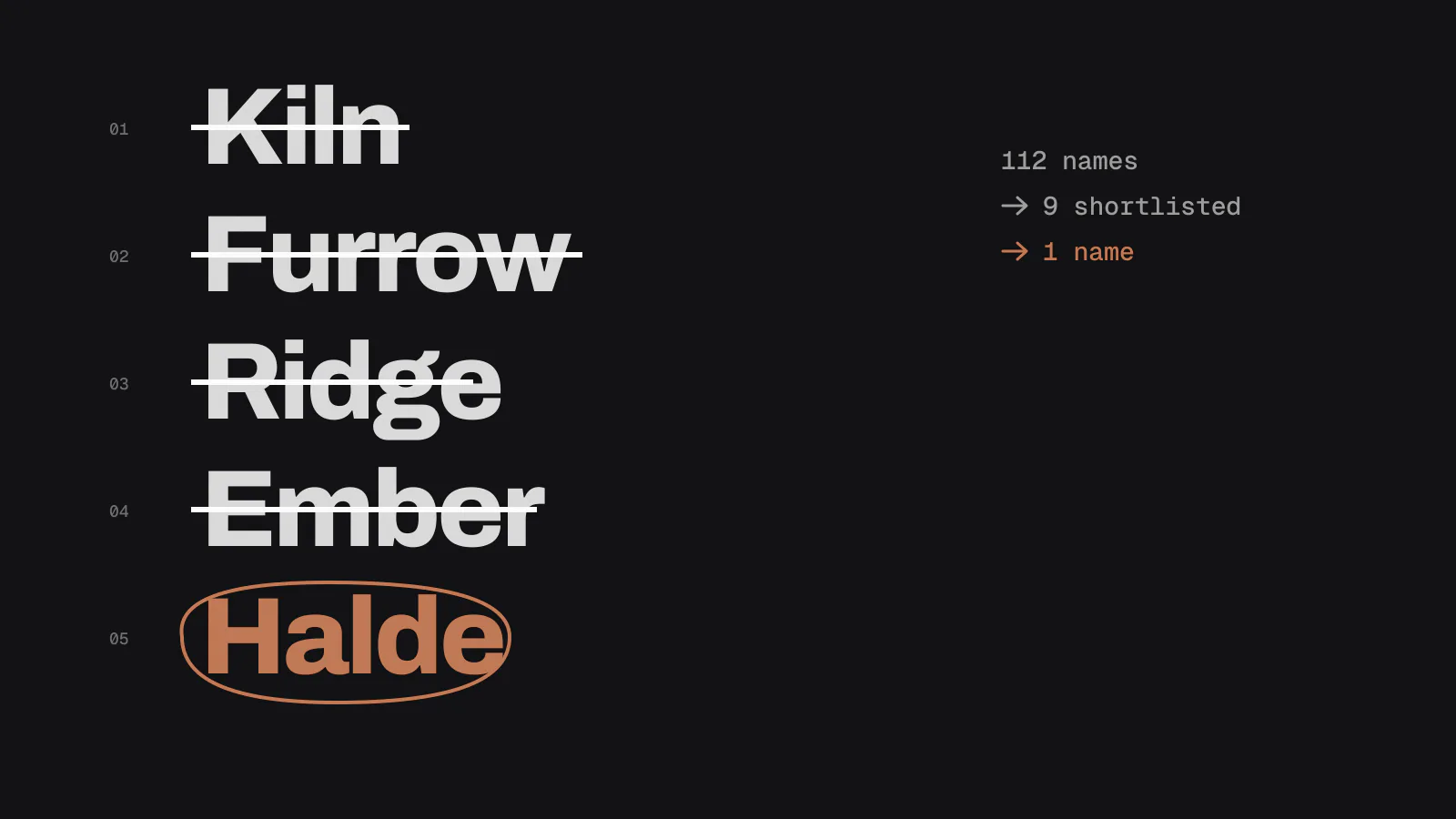
We wrote sixty names over two weeks. Three of us worked separately at first, to avoid all drifting towards the same idea, then pooled the lists. They fell into rough groups:
- Place names: the street, the polder, the nearby river, old field names from a 19th-century map of the area
- Process words: things from roasting and farming that aren’t about coffee directly
- Invented words: short, sayable, meaning nothing yet
- People: Wessel’s grandparents, the dairy’s original owner
The people names went first. Wessel was clear that the whole point was to stop the business being named after a person.
The checks
Every name on the shortlist goes through the same checks before a client sees it. We do these ourselves and then hand the survivors to a trademark attorney, because a name we can’t register is a name we shouldn’t have shown.
| Check | Names removed | What we looked for |
|---|---|---|
| Pronunciation | 14 | Read aloud by Dutch, English and Portuguese speakers in the studio |
| Meaning | 6 | Unfortunate meanings in Dutch, French, English, German or Portuguese |
| Domain | 9 | A usable .nl or .com, or a clear alternative |
| Trademark (our search) | 16 | Similar marks in coffee, food or drink in the Benelux and EU |
| Trademark (attorney) | 3 | The formal search on the remaining dozen |
That left twelve names. We presented six of them, with a short paragraph on each and the name set in three simple ways, on a bag, on a sack and in a sentence. We didn’t design logos for any of them. A finished logo makes a weak name look strong and makes a good name look wrong if the logo is off.
Why Halde
Halde is an old regional word for a slope. The roastery is in a former dairy at the foot of a dyke, and the delivery van has to climb a short, steep ramp to reach the road. Everyone who has ever visited mentions the ramp. That gave Wessel his one sentence.
It also passed every check cleanly. Five letters, two syllables, said the same way in Dutch and English, and the attorney found nothing close in the food and drink classes.
It wasn’t anyone’s first favourite. Wessel liked an invented name more, and two of us preferred the name of an old field on the map. We took the shortlist of three to Wessel’s family and his two staff over coffee, without telling them anything about the names, and asked which they would remember tomorrow. Halde won. When we rang them the next day, all of them could still spell it.
If a name needs the logo to make sense, it’s the wrong name. If it needs a paragraph, it might still be the right one.
What we’d do differently
We’d start the trademark search earlier. Sixteen names fell at our own search, and some of them had already become favourites. Next time we’ll run a quick check on the long list before anyone gets attached.
We’d also include the staff from the start. The two people who pack the bags had better instincts for what sounded right on the phone with a café owner than anyone in our studio. They are the ones who say the name out loud fifty times a week.